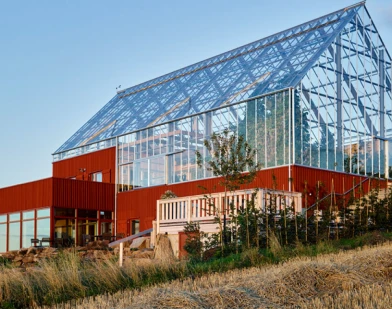
Birch seed greenhouse at “Zābaki” - knowledge instead of a harvest
Why does a birch need a greenhouse?
Birch breeding has been carried out in Latvia for three decades. The Birch Programme of AS “Latvijas Finieris” was launched in 1996, and its aim is to promote responsible land management and the growing of high-quality birch. Over thirty years the area of birch stands in Latvia has doubled, reaching approximately 882 thousand hectares.
The problem the greenhouse solves is simple and fundamental at the same time. Seeds of selected birches are obtained by pollinating chosen trees with chosen pollen. In the open field this is impossible - the wind brings pollen of unknown origin, and decades of breeding work turn into chance.
An enclosed greenhouse eliminates that chance. Forty-eight selected outdoor birch plants have been placed in the new greenhouse; the one-year-old plants are approximately 0.5 metres tall. Controlled conditions allow precise, directed pollination, and the plants grown from the resulting seed are expected to show higher productivity, better stem quality and greater adaptability.
“Investment in birch breeding is investment in the forest of the future.”
Artis Podnieks, Member of the Board, AS “Latvijas Finieris”
In this project AS “Latvijas Finieris” cooperates with the Latvian State Forest Research Institute “Silava”.
The facility in figures
| Indicator | Value |
|---|---|
| Greenhouse dimensions | 15 × 46 m |
| Floor area | 690 m² |
| Volume | approx. 5,850 m³ |
| Selected birch plants | 48 |
| Location | “Zābaki” tree nursery, Krimulda Parish |
| Start of construction | June 2026 |
| Contractor | SIA “TERMOLAT” |
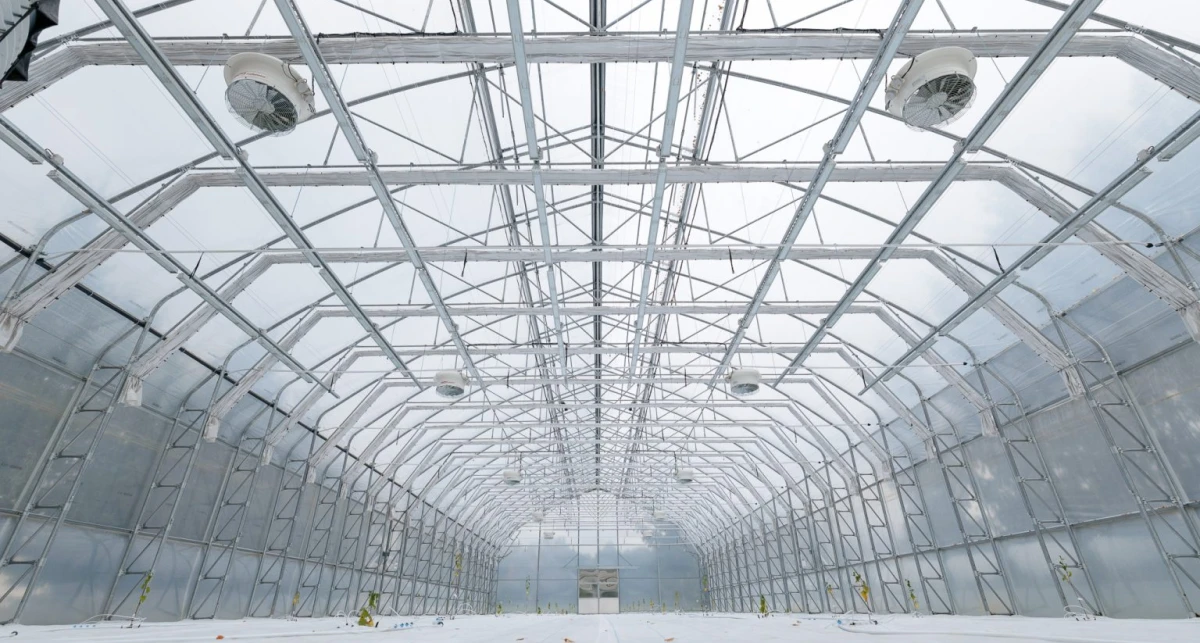
The proportions here are unusual. A volume of 5,850 m³ over a floor area of 690 m² means an average height of about 8.5 metres - far more than in an ordinary nursery greenhouse. The reason is quite simple: the birches have to grow, and the building must still serve its purpose when the trees are no longer half a metre tall.
It is precisely because of this volume that every engineering solution at the facility was planned differently from what would be done in a standard seedling greenhouse.
A large building volume means stratified air
In a tall space, warm air rises and stays under the roof. A cooler, more humid layer forms at floor level. The difference between top and bottom can reach several degrees, and it is this stratification that creates two problems: plants grow unevenly, and moisture condenses on the cooler surfaces, which is a direct route to plant disease.
In a birch seed greenhouse these problems carry an additional cost. An uneven microclimate means uneven flowering, and if the trees do not flower at the same time, the window for controlled pollination narrows.
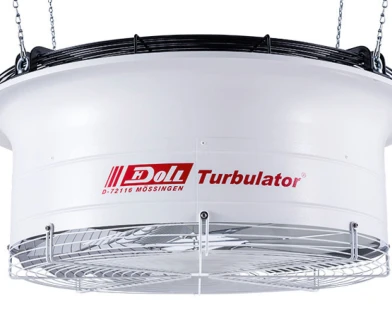
The solution - air recirculation fans (turbulators). These are fans placed in the roof zone that continuously mix the air already inside the space, rather than forcing fresh air in from outside. In practice this brings three benefits:
- Uniform temperature throughout the volume. Warm air is returned downwards from the roof, and the vertical temperature difference is evened out.
- Humidity control without ventilation. Moving air dries the leaf surface and condensation does not form. This matters, because ventilation also means losing heat - whereas the fans make it possible to control humidity without opening the vents.
- More stable conditions during the pollination period. When climatic conditions are the same throughout the space, plant development is also more synchronised.
These fans consume comparatively little energy but affect the operation of the entire greenhouse - in our experience they are without doubt one of the most cost-effective improvements in a high-volume building.
Irrigation and the water storage tank
The central element of the irrigation system is the water storage tank installed inside the greenhouse. It is not merely a reservoir.
- Water temperature. Cold water straight from the borehole is a stress for the roots and slows growth. In the tank the water warms to room temperature, and the plants receive it at a temperature at which they are able to take up nutrients.
- Independence from the capacity of the source. An irrigation cycle requires a large volume of water in a short time. The tank evens out this peak in demand - the borehole or supply line can work steadily around the clock, replenishing the reserve, instead of covering a sudden surge in consumption.
- Water quality and fertilisation. A stable reserve makes it possible to dose fertiliser precisely and to monitor the water parameters before it reaches the plants.
- Security. If a fault occurs in the water supply, the reserve in the tank provides time to deal with it without putting at risk breeding material whose value is measured not in euros but in decades of work.
The tank is complemented by a pump and dosing unit with filtration, and the whole system is connected to the climate control automation.
Climate control: one system, not separate devices
At this facility, heating, irrigation, ventilation, air recirculation and grow lighting are not separate mechanisms but a single controllable system with remote monitoring.
The practical difference becomes apparent at moments when parameters conflict. On a spring morning there is too much humidity inside, but it is still cold outside. The automation does not ventilate - it switches on the recirculation fans and, if necessary, engages the heating, because opening the vents would mean letting the heat out. At midday, when the temperature rises, the sequence is reversed. The system makes such decisions itself, on the basis of sensor readings, rather than waiting for an operator to be present.
At a tree nursery, where there is no round-the-clock duty shift, this is essential.
Energy efficiency in a large volume
An eight-and-a-half-metre-high greenhouse in the Latvian climate is a serious consumer of heat, and so energy efficiency was not an addition to the project but a basic requirement. The logic behind the solutions is simple: the cheapest energy is the energy that does not have to be produced.
- An airtight structure with properly sealed junctions around the vents and doors.
- Air recirculation for humidity control instead of ventilation - the heat stays inside.
- Heating controlled by actual demand rather than by a schedule.
- Irrigation water that warms passively in the tank instead of being heated.
Individually these are small gains, but together, over a season, they add up to a considerable difference.
What this project means to us
To build a facility that holds thirty years of accumulated breeding work is a matter of trust, and trust is not won with a price offer. We are pleased and grateful that AS “Latvijas Finieris” entrusted this task to us, and we take it as an endorsement of the work we have done on previous projects.
It is the more challenging projects that inspire us. When the requirements are high and standard solutions are not enough - when the best option for a unique situation has to be found - that is work we do with pleasure.
The purpose of our work is simple: to help clients arrive at modern, efficient and automated solutions that make everyday work easier. When the automation itself keeps track of temperature, humidity and irrigation, nobody has to walk out at night to check the sensors - instead they can concentrate on what genuinely matters. At a tree nursery that is breeding and seedling quality, not opening the vents at the right moment.
That is the value we want to leave behind at every facility. Because we truly care about nature, science and construction.
Factual information on the purpose and parameters of the birch seed greenhouse and on the Birch Programme has been republished from official announcements by AS “Latvijas Finieris”:
https://www.finieris.com/lv/ar-skatu-nakotne-svinot-berzu-programmas-tris-desmitgades/